I'm a coach, author, and entrepreneur who loves to talk about business & entrepreneurship, personal development, and marketing & branding. Subscribe to my newsletter.
A New Threshold in Fractal Time Research
|
A New Threshold in Fractal Time Research Today I am sharing an important milestone. I have published my next internal research papers documenting a significant shift in the formal understanding of Fractal Time. For more than a decade, my working understanding has been consistent: time does not behave as a simple linear progression. Time is fractal. It carries recursive depth, relational structure, and properties that resemble those found in quantum systems more than in classical linear models. This understanding did not arise from a single insight — it is the result of long transdisciplinary work across mathematics, hypergeometry, systems theory, embodiment, and direct practice. What has changed is the level of precision. The new formalization rests on a clear mathematical foundation: a documented 24-element sequence organized as a matrix of six quadrigas. From this structure, twelve structural relations have been extracted and organized into a coherent relational grammar — pairs such as Generation ↔ Regeneration, Oscillation ↔ Frequency, Completion ↔ Embodiment, and Forward ↔ Backward Generation. These relations describe how temporal processes move, transform, complete, and renew themselves. A further architecture — a recursive addressing system built from twelve primordial elements — extends this into a method for describing any moment or process with hierarchical precision. The central relational finding is this: Regenerative time moves through two complementary, simultaneous and oscillating orientations — one toward emergence and generation, the other toward embodiment, completion, and regeneration. These are not two separate systems. They are two directions of the same temporal field, continuously exchanging through identity and relation. In familiar language, one could say there are two arrows of time that remain in living conversation rather than pointing in absolute opposition. This is the magnitude of the shift: We are moving from the understanding that “time is fractal” to a precise relational grammar of how temporal processes generate, oscillate, transform, complete, and regenerate themselves. The numerical and geometrical structures are no longer only symbolic or descriptive. They are becoming a coherent formal foundation to operate in the quantum lattice. This level of clarity is theoretically significant. It also begins to open a larger possibility: that temporal structure itself could become the basis for a new class of technologies — technologies designed not merely around clocks and duration, but around temporal relationships, regeneration, and human capacity. This remains research. The next phase is to test the grammar against lived processes at different scales. But the direction has shifted substantially: from understanding time → to modelling time → to foresight in time -> to potentially engineering with temporal structure and fractal time algorithms. The next phase begins now. — Luis Daniel Maldonado Fonken www.luisdanielmaldonadofonken.com
|
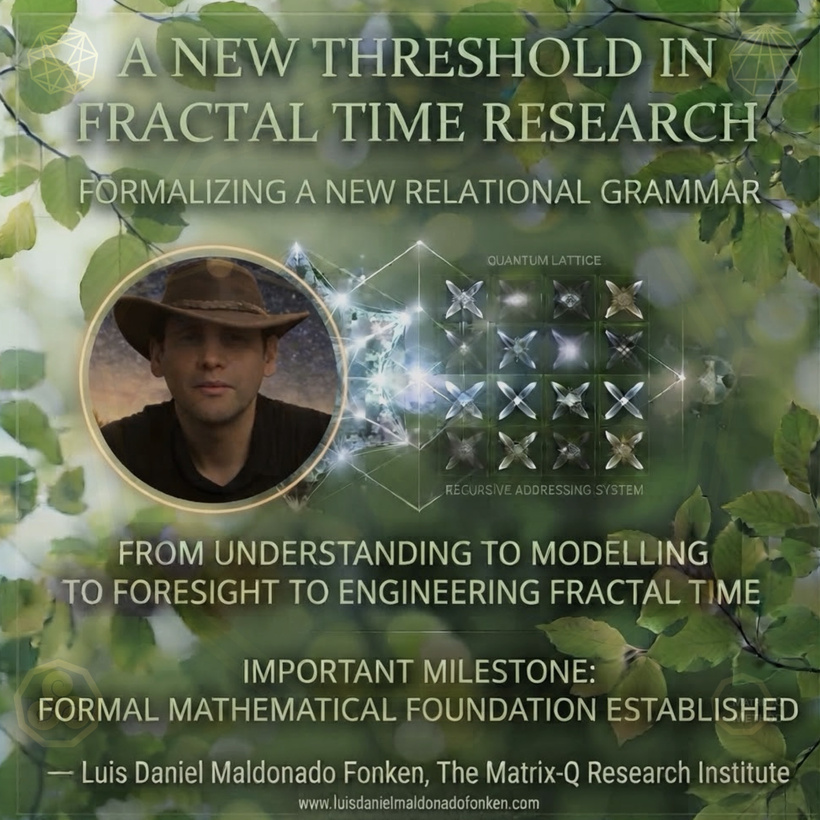
Luis Daniel Maldonado Fonken
I'm a coach, author, and entrepreneur who loves to talk about business & entrepreneurship, personal development, and marketing & branding. Subscribe to my newsletter.
TIME IS CAPITAL. There is another way to relate to time. Not by managing it more efficiently. Not by filling it more completely. But by learning to operate with time as a living dimension of creation. After years of research, experimentation, and practice, I am opening the Fractal Time Foundation Experience. A private, founder-led 40-minute experience with me, designed to introduce you to the first transition into Fractal Time. I will share the journey behind its development, the principles...
A Private Introduction to Fractal Time 24 September · 13:00 CEST · 80+ minutes Tomorrow, I’m opening a focused 72:20 Fractal Time experience for a small group. For several years, I have been practicing fractability—developing and refining a way of working with time that goes beyond conventional productivity. The 72:20 approach creates a structured environment for working, regenerating, learning, creating, embodying, connecting, and transforming your competencies, natural interests, and life...
Creating something changes the relationship with time. But another question eventually appears: Who does this creation serve? I have experienced this many times. An idea can feel valuable simply because it matters to me. But when another person can use it, learn from it, experience it, or build upon it, something changes. A thing leaves the room Another person finds meaning Value crosses the space The transition is: Creation → value. A skill becomes useful. An idea becomes a solution....